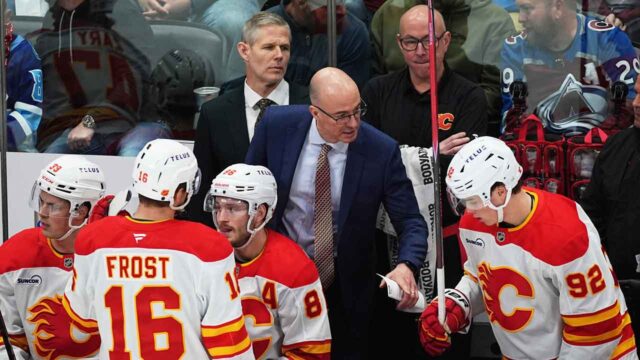
CALGARY – The one thing you could count on from the Calgary Flames the last handful of years was a healthy work ethic.
Win or lose, they weren’t often out-competed.
But the way Ryan Huska sees it, their dedication, perseverance and industriousness is no longer enough.
“We're at the point now where I think our team has an identity,” said Huska of his crew’s workmanlike approach.
“But now we’ve got to build on the foundation that we've been able to create. We have to become more of a complete team. We know what we have to be, but it's time for the next step.”

32 Thoughts: The Podcast
Hockey fans already know the name, but this is not the blog. From Sportsnet, 32 Thoughts: The Podcast with NHL Insider Elliotte Friedman and Kyle Bukauskas is a weekly deep dive into the biggest news and interviews from the hockey world.
Latest episode
And that, said Huska, means finding a way to score more goals.
It’s been a problem here for a while.
Last year the Flames were dead last in the league, at 2.54 goals per game, and they’ve since lost their two best goal scorers, Nazem Kadri and Blake Coleman.
Their two most productive defencemen are also gone too, in MacKenzie Weegar and Rasmus Andersson.
And while the rest of the hockey world looks at this team as a cinch to finish dead last in lamp-lighting once again, it doesn’t mean Huska and the team are okay with their pop-gun offence also being part of their identity.
Addressing what he suggested was the players’ offensive “stubbornness,” Huska said he’s drilled two things into the players early in camp – shoot the puck more often and get to the front of the net with more urgency.
Get greedier, get greasier.
Stop passing up chances to hit the net, and stop making it so easy for opposing goalies to save it.
“When you get a chance to shoot the puck, shoot the puck, go to the net hard, and make sure you're stopping at the net,” said Huska, of a task proven easier said than done since he took over a retooling team three years ago.
“They get in their habits of overpassing at times. People have a chance to shoot a puck, but think, ‘I might have a better option to make this play to the guy off the backside’ that you don't connect on.”
Anyone who has played hockey at any level is aware of both aforementioned aids to beating more goalies.
But given just how stripped down the offence has become following three years of significant selling, it’s THE point of emphasis this fall.
“We've talked about it at length so far, and it's something we're going to have to do,” said Huska, whose club has scored the third-fewest goals in the NHL over the last three years.
“We look at a lot of clips over the course of the summer, and we have some Grade A scoring chances coming down on one of these NHL goaltenders, and even if you're in a prime scoring area, nine out of 10 times you're not scoring on them. If you put someone in front of them, and you bother them a little bit with their sightlines, now you increase your odds. So we have to be willing to be a little bit more uncomfortable when it comes to that side of the game. You want to score goals, you’ve got to go there, and you have to be willing to pay a price to score.”
Huska said when he first arrived in Calgary, head coach Bob Hartley had his players stop in front of the net after every single shot.
Every drill was punctuated with crease-front congregations.
“It's guys standing at the front of the net, but not quite in the goaltender's eyes, thinking, ‘I'll just wave my stick at it and hope I get a nice deflection goal,’” said Huska of a tendency he’s noticed in years past.
“That stuff doesn't work. So it's breaking a mindset a little bit for them to get them greasier.
“We have certain players, like an Adam Klapka, who will go there consistently. But Connor Zary has to go there, and he's got to stand right in front of the goaltender's eyes when it's called for. As do Matt Coronato and Ryan Strome. They all have to be a part of that, and it's hard for some of them to develop new habits, so that's one area that we're going to push a lot of. We'll keep building on that as the season moves on.”
Craig Conroy has suggested that because his young team is bereft of proven, star finishers, the team would likely count on its mobile blue liners to help create more scoring from the back end.
The reality is, it will take years for this club to skyrocket up the scoring charts like San Jose did last year, when they went from 32nd to 17th.
The Flames don’t have a Macklin Celebrini, a Will Smith, a Michael Misa, or a Tyler Toffoli.
They have Matt Coronato, Morgan Frost, Joel Farabee and Matvei Gridin, who will all be given the type of ice time and opportunities to push beyond the 20-goal mark most people have them tabbed for.
Asked if there is a fine line between opening up the game at the expense of defence, Huska shook his head.
“It's not opening things up - it’s just small details that you ask the players to do: stopping at a net off a rush, not circling away,” he said.
“Our structure, the way we expect to play the team together and the connectedness of it, hard at the red lines, making sure there's no easy access to our zone… all that stuff is not changing. It's the little details within our game that we're going to ask more of them.”